


If you're a lawyer using free ChatGPT or Claude for client work, you need to stop immediately.
In United States v. Heppner (25 Cr. 503 (JSR), S.D.N.Y., February 10, 2026 (transcript here), Judge Rakoff ruled that the use of consumer-tier AI tools - the free versions of ChatGPT, Claude, and similar platforms - can waive lawyer-client privilege because these tools share data with third parties without confidentiality protections.
Here’s what happened:
A defendant used the free version of Claude to create defense strategy documents.
The Defendant claimed privilege over these documents. The Government moved to compel production.
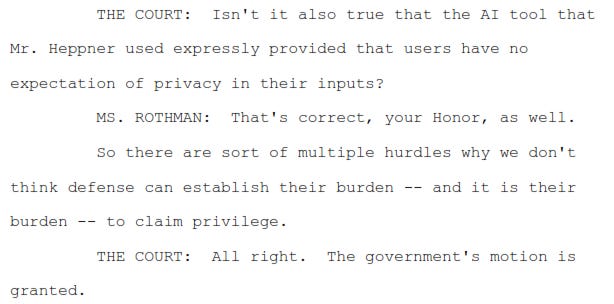
Judge Rakoff disagreed:
The Three Dimensions Of Risk
It’s important to note that the information at issue here was not communication exchanged between a lawyer and client. The information being disclosed was the conversations that the Defendant put into Claude prior to sending to their lawyer.
The underlying principle being applied is not controversial:
Privilege is waived where privileged information is disclosed to a third party without confidentiality guarantees.
Consumer AI tools explicitly state in their terms that your inputs may be used for training or shared.
That’s third-party disclosure. Privilege gone.
I’m still thinking of the implications here.
Most lawyers will think that the problem will be solved simply by using a paid tool.
But its not that simple.
The Heppner ruling exposes three separate risks and the other two are worse because lawyers have no control of these risks.
What YOU'RE Using. This is the obvious one - your AI tool choices matter. Free ChatGPT, free Claude, free Gemini all have terms permitting training on your inputs. Use of these tools waive privilege. But switching to paid versions isn't enough.
What You THINK Is Safe. Paid ChatGPT Plus isn't automatically privilege-safe. Not all paid tools guarantee confidentiality - terms of service vary wildly. Some retain data. Some use it for improvements. Some share with affiliates. You need systematic tool evaluation, not just a credit card upgrade."
Risk 2: How The AI Tool Uses. Most lawyers don’t read the terms of service of an AI tool - let alone be competent in understanding their implications. Fact is not not all paid AI tools guarantee confidentiality - see ChatGPT. Moreover, any guarantees in terms of services may change in the future.
Risk 3: How Your Clients Use: this is the scenario I’m more concerned about:
You draft a privileged litigation strategy memo. You email it to your client.
Your client doesn’t understand the legal jargon, so they copy-paste it into free ChatGPT and ask: “Can you simplify this for me?”
By your client doing so they waive solicitor-client privilege.
In this latter scenario , you did everything right. however privilege is still waived because of what your client did.
For solo lawyers specifically, this is catastrophic. You lack the infrastructure larger firms have to monitor client technology use. You're personally liable for privilege failures. And your clients trust you to guide them - when privilege gets waived, they'll blame you for not warning them
I’ll be writing more about what lawyers need to be considering in light of this decision.
However your immediate actions for now:
Lawyers: If you're using free AI tools (whose terms permit training/sharing), you risk waiving privilege on everything you input.
Clients: Take the necessary steps to ensure clients who use free AI tools to work with you (e.g. scenario above), they are paying for the tools that they are using.