It’s been a few months since you’ve heard from me, and I owe you an explanation.
Since September, I’ve been completely immersed in a multi-day commercial arbitration that pulled me away from everything else - including this newsletter and the regular insights I’ve been sharing with you.
The case concluded a few weeks ago - and I want to share with you how what I learned during this experience changed everything I thought I knew about the practice of law as a solo lawyer in 2025.
The Case - And The Irony
I represented a minority shareholder founder whose co-founders wanted out while keeping the intellectual property she’d disclosed to the company.
IP she’d developed over decades.
Without compensation.
Without permission.
Here’s where it gets interesting: her co-founders believed that AI changed the rules entirely.
Their logic? If AI can eventually figure something out, it’s not a secret worth protecting. Once information exists “out there,” artificial intelligence makes it non-confidential.
As a consequence, they felt the liberty to feed her frameworks, methodologies, and specialized knowledge into AI systems to scale and commercialize her expertise - without her consent.
The irony hit me during late-night preparation sessions: I was fighting for my client’s right to control how AI uses her intellectual property while simultaneously using AI to practice better law than I’ve ever practiced before.
This case forced me to confront a false choice I’d been wrestling with - and I suspect you’ve felt it too
The Binary Trap
You’ve probably felt the pressure building:
Become an “AI lawyer” who embraces technology fully, or
remain a “traditional practitioner” who protects professional standards by avoiding it entirely.
The company exemplified one extreme of this binary - represented by a senior legal counsel from a BigLaw firm, supported by a junior associate, and financial and legal resources that dwarfed that of my client and I.
While I certainly had a background in IP licensing law and litigation, the expedited three-month timeline meant that traditional practice would require compromise: incomplete analysis, surface-level preparation, or burning out my team.
I had to decide: resist AI to protect professional standards, or embrace it and risk becoming what my opposing counsel represented?
I chose to embrace AI purely out of necessity—a choice that in hindsight negated every advantage the bigger law firm had against me.
I chose to embrace the use of AI purely out of necessity - a choice that in hindsight negated every strength the bigger law firm had against me.
Why The Choice Is Actually False
Looking back, here’s what was confirmed during those three months: AI isn’t replacement technology. It’s amplification technology.
Think about what AI actually does.
It recognizes linguistic patterns and predicts statistically likely outputs based on billions of examples. It doesn’t “know” law. It doesn’t “understand” your client’s situation. It can’t determine which legal arguments will resonate with a particular arbitrator or judge based on relationship dynamics and courtroom observations.
AI is pattern recognition, not intelligence. Pattern recognition doesn’t compete with strategic judgment—they’re complementary capabilities.
This is why the binary choice is false. The real question isn’t “AI or human?” The real question is: which tasks should pattern recognition handle, which require strategic judgment, and how do they work together to create better outcomes?
The Integration Insight
When I decided to use AI as my junior associate, I committed to leverage these strengths to access capabilities I’d never had access to before:
Generating complete summaries of each day’s hearing transcript within hours of receipt. A junior associate would need eight hours to identify key testimony, contradictions, and strategic implications. With AI handling the pattern recognition - pulling quotes, identifying inconsistencies, organizing by theme - I could do it in under two hours with better results.
Cross-referencing witness testimony with evidence to compile credibility frameworks. AI could process hundreds of pages and flag every instance where testimony conflicted with documents or prior statements. This showed me exactly where witnesses were vulnerable.
Building dynamic cross-examination roadmaps that evolved with each day’s testimony. When a witness said something unexpected, I had new cross-examination strategies ready within hours. AI generated the options based on patterns in the testimony.
The real breakthrough here wasn’t speed - it was depth.
With AI handling volume analysis, I uncovered patterns that I would have missed due to time constraints. More importantly, strategic options I hadn’t considered became obvious when I could test them against complete information.
The crucial distinction here: AI was my associate, not my replacement.
Not my equal. My associate.
The quality of output depended entirely on the quality of integration. The more detailed context I provided - the pleadings, specific facts, key documents - the output provided by AI became genuinely useful.
The output further improved as I iterated based on initial results, refining prompts with additional strategic direction.
Output value = (Your context + Your expertise) × (AI’s pattern recognition)
Taking The Integration Approach
The lawyers struggling most with AI are those still trying to choose between expertise and technology. Conference panels debate “AI versus human lawyers.” Articles proclaim either that AI will eliminate legal jobs or that it’s useless hype.
What I discovered through three months of intense integration: the effective uise of AI meant that I had the analytical capability of a ten-person BigLaw team while maintaining the strategic judgment that comes from actually understanding the case.
The efficiency I gained through using AI effectively meant that I spent more time refining opening and closing statements and perfecting cross examination roadmaps.
But perhaps most importantly, my experience shows that you can in fact be future-ready without compromising professional standards.
You can embrace technology without abandoning judgment.
The lawyers who will thrive aren’t those who avoid AI or those who trust it blindly like the company did with my client’s IP. They’re those who realize there was never a choice to make - only an integration to master.
My absence from this newsletter taught me something I couldn’t have learned any other way: The traditional solo and small firm disadvantage? It’s over - but only if you integrate AI effectively rather than stress about the choice of AI.
Over the coming weeks I’ll break down exactly how I used AI for each phase of this arbitration.
Not theoretical frameworks, but the actual workflows and tools I used in real, high-stakes litigation - including how you can gain access to the same tools so you can leverage these workflows in your own practice.
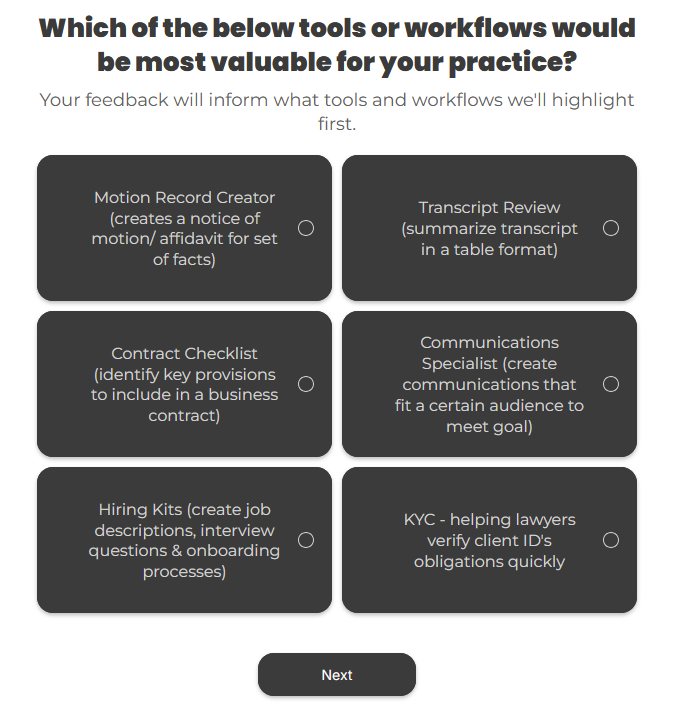
Access our survey to tell us which tools you’d like us to highlight first!